2026 Dreamhack Atlanta Group A
Esipenko Beats Tang in DreamHack Atlanta Quarterfinal


Tang's Italian Dream
Esipenko Takes Down Tang in DreamHack Atlanta Quarterfinal
Andrey Esipenko secured his spot in the upper bracket semifinals at DreamHack Atlanta 2026 with a clean victory over Andrew Tang in their quarterfinal clash. The Russian GM, fresh off grabbing the final spot in the 2026 FIDE Candidates Tournament, converted a small but persistent edge from an Italian Game into a full point, leaving Tang's tournament hopes hanging by a thread.
The game lasted just 14 moves in the broadcast before Tang resigned, but those moves told a story of steady pressure and a Black setup that never quite found its footing. Esipenko, rated 2684 and riding high after his Candidates qualification, showed the kind of positional squeeze that has made him a fixture in the world's top 40.
The Italian Setup and Tang's Kingside Gamble
Both players entered familiar territory with 1.e4 e5 2.Nf3 Nc6 3.Bc4 Nf6 4.d3, the Modern Bishop's Opening variation of the Italian Game. This quiet approach has become a staple at the top level, offering White long-term pressure without the theoretical landmines of the Giuoco Piano's sharper lines.
Tang's choice to fianchetto his kingside bishop with 6...g6 was the first sign of an ambitious defensive setup. The idea is sound in principle—the bishop on g7 will survey the long diagonal and support a potential ...f5 break—but it requires precise timing. The problem? Esipenko wasn't going to give him that time.
After 7.d4, Esipenko immediately challenged the center, and Tang's 7...Qe7 signaled he was committed to a slower game. The queen move prepares to castle kingside while keeping options open for ...Nd8-e6 maneuvers, but it also meant Black was playing catch-up in development.
The engine kept the evaluation around +0.6 throughout these moves—not a decisive advantage, but the kind of edge that compounds over time in rapid chess. Engines call this "equal-ish," but any club player knows the feeling: White has easy moves, Black has to find precise ones.
Esipenko's Knight Maneuver: Simple but Effective
The critical strategic sequence began with 10.a4, a move that looks slow but carries real venom. Esipenko was preparing to activate his knight via a3-b5, eyeing the weak c7 square and the d6 pawn. Tang responded with 10...a5, the standard reaction to prevent b4 expansion, but this fixed the queenside pawns and gave Esipenko a clear target.
11.Na3 followed by 12.Nb5 was textbook Italian Game play. The knight on b5 is a monster—it threatens to land on d6 or c7, and Black has no good way to challenge it. Tang tried 12...Na7 to exchange it off, but after 13.Nxa7 Rxa7, the damage was done. Black's rook is misplaced on a7, the queenside is slightly weakened, and White has achieved everything he wanted from the opening.
This is where the gap between engine assessment and human experience becomes stark. The computer might show +0.65, suggesting rough equality, but for Tang, every move required calculation while Esipenko could play on autopilot. In rapid chess with 10 minutes on the clock, that's a massive practical advantage.
The Position That Never Materialized
After 14.b3, the game reached a position where Esipenko had a clear plan: complete development, prepare d5 or f4 breaks, and slowly squeeze. Tang's position wasn't losing by any stretch, but it offered no counterplay. The bishop on g7 was biting on granite, the rook on a7 was doing nothing, and the f8 rook had nowhere to go.
The resignation came shortly after—not because of an immediate tactical blow, but because Tang recognized the writing on the wall. In a knockout format where every result matters, defending a slightly worse position for 30 more moves with no winning chances is a losing proposition. Better to save energy for the must-win games ahead.
This is the cruel reality of modern rapid chess. A 130-point rating difference (Esipenko at 2684, Tang at 2551) doesn't mean one player is dramatically better than the other, but it does mean one player is more likely to find the right moves when the position gets complicated. Esipenko never let it get complicated.
What This Means for Both Players
For Esipenko, this win continues a strong 2026 campaign. After the heartbreak of a blunder that nearly cost him his Candidates spot, he's shown resilience and form at exactly the right time. The DreamHack Atlanta event, while not carrying the prestige of a classical super-tournament, offers prize money and rating points that matter for a player looking to establish himself in the 2700+ club.
Tang, known online as "PenguinGM," remains one at this level. In the upper bracket format, he'll need to find a way back through the lower bracket if he wants to stay alive in the tournament.
The Italian Game continues to prove its worth at the highest levels. Unlike the sharp Sicilians or the theoretical battlegrounds of the Ruy Lopez, it offers White a risk-free way to pose problems. Esipenko's handling of the opening phase—patient, positional, never overreaching—is a template for how to convert a small edge into a full point.
A Quiet Win with Lasting Lessons
Not every decisive game features a spectacular sacrifice or a king hunt. Sometimes, chess is about small edges, accumulated advantages, and knowing when your opponent has run out of ideas. Esipenko's victory over Tang was exactly that kind of game—professional, efficient, and utterly controlled.
The position after move 12, with Esipenko's knight dominating on b5, is the kind of thing we turned into a print at ChessFlow. Clean, instructive, and a reminder that positional chess can be just as beautiful as tactical fireworks.
As DreamHack Atlanta 2026 continues, Esipenko moves forward with momentum while Tang faces the gauntlet of the lower bracket. In knockout chess, there are no second chances in the upper bracket—and today, Esipenko made sure Tang wouldn't get one.
The quarterfinals continue with more matchups to come, but this game served notice: Esipenko is playing serious chess, and anyone hoping to stop him will need to bring their best.
1.e4 e5 2.Nf3 Nc6 3.Bc4 Nf6 4.d3 h6 5.O-O d6 6.c3 g6 7.d4 Qe7 8.Re1 Bg7 9.h3 O-O 10.a4 a5 11.Na3 Kh7 12.Nb5 Na7 13.Nxa7 Rxa7 14.b3 exd4 15.e5 Nd7 16.exd6 Qxd6 17.Ba3 c5 18.Nxd4 Qf6 19.Nb5 Ra6 20.Ra2 Qg5 21.Bc1 Qh4 22.Rae2 Rf6 23.Qd2 Nb6 24.Bd3 c4 25.Re4 Qh5 26.Be2 Qc5 27.Rd4 Re8 28.Bxc4 Rxe1+ 29.Qxe1 Be6 30.Bxe6 Rxe6 31.Re4 Rxe4 32.Qxe4 Nd5 33.c4 Nb4 34.Qxb7 Qf5 35.Be3 Nc2 36.Qf3 Qe6 37.Bd2 Qd7 38.Qd5 Qe7 39.Bxa5 Na1 40.c5 Qe2 41.c6 Qc2 42.Qc4 Qd1+ 43.Kh2 Be5+ 44.f4 Bd6 45.Nxd6 1-0
How would it look as art?


Own a piece of chess history. Transform this legendary game into a unique piece of art for your home or office.
Perfect For
- Unique Gifts for chess enthusiasts and players
- Tournament Prizes that winners will treasure
- Club Decor for chess clubs and gaming spaces
- Office Art showcasing strategic thinking
- Personal Collection of historic games
Turn Your Games Into Art
Whether it's your own game from Chess.com or Lichess, or another historic masterpiece, transform any chess game into a stunning visual artwork.
You might also like
More legendary chess game stories
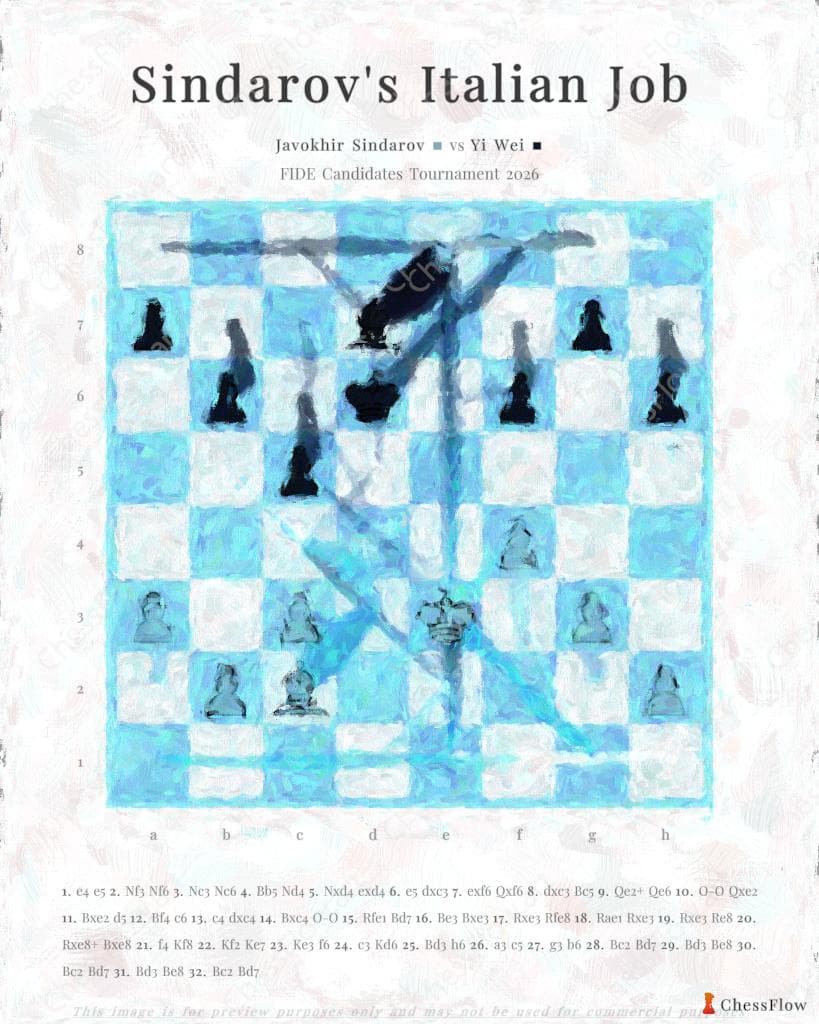
Javokhir Sindarov vs Yi Wei
Javokhir Sindarov vs Yi Wei
The Opening Javokhir Sindarov and Yi Wei opened round 14 of the 2026 FIDE Candidates Tournament with the Four Knights Game, specifically the Spanish Variation, Rubinstein Variation Accepted (ECO C48)...
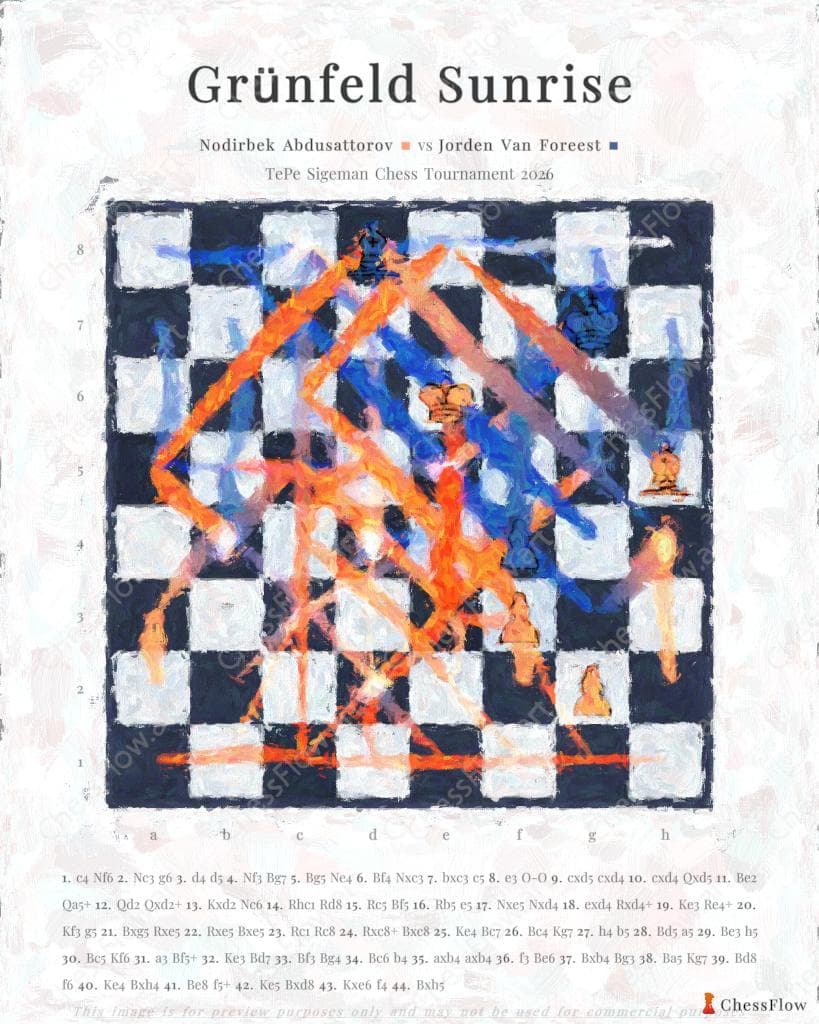
Nodirbek Abdusattorov vs Jorden Van Foreest
Nodirbek Abdusattorov vs Jorden Van Foreest
A Quiet Day in Malmö Nodirbek Abdusattorov and Jorden van Foreest split the point in round 7 of the TePe Sigeman Chess Tournament 2026, a game that never really caught fire. The Grünfeld Defense led...
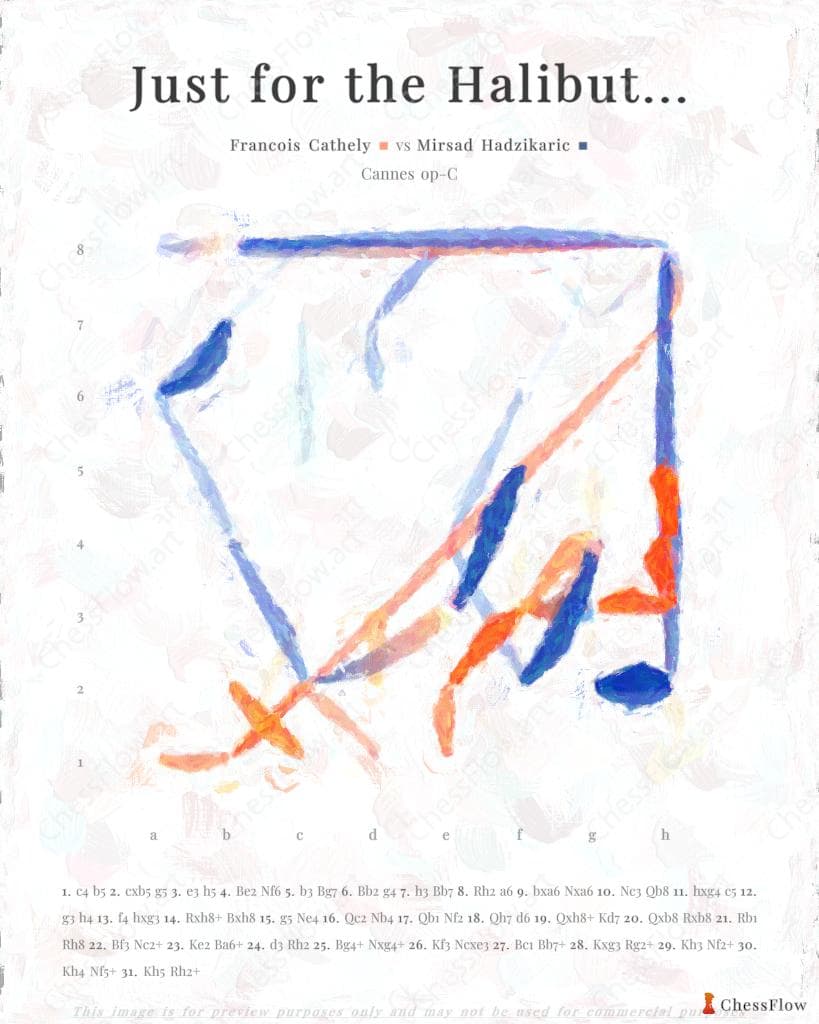
Francois Cathely vs Mirsad Hadzikaric
Francois Cathely vs Mirsad Hadzikaric
The Opening Gambit Francois Cathely and Mirsad Hadzikaric faced off in the 1995 Cannes op-C tournament with an opening that immediately signaled chaos was coming. After 1.c4 b5, Black's Polish Defens...