Championnat de France des Clubs 2026 | Elimination | Groupe B
Harikrishna and Anton Guijarro Draw in French Club Championship


French Club Shadows
A Quiet Day in the French Club Championship
Pentala Harikrishna and David Anton Guijarro split the point in Round 7 of the Championnat de France des Clubs 2026 elimination stage, a draw that satisfied neither player but surprised no one. Both grandmasters navigated a Caro-Kann Advance into a symmetrical pawn structure, traded pieces methodically, and shook hands with the position offering nothing for either side. In team chess, sometimes a draw on a top board is exactly what you need — and sometimes it's just a draw.
The game unfolded on board 42 of Group B's elimination round, with Harikrishna (rated 2676) playing for Asnières - le Grand Échiquier and Anton Guijarro (2657) representing Châlons-en-Champagne. Both players came into this round with solid tournament performances — Harikrishna had already notched wins earlier in the event, while Anton Guijarro has been hovering around the 2657 mark after a steady climb from 2625 last summer.
The Caro-Kann Goes Nowhere Fast
The opening moves telegraphed the game's trajectory. After 1.e4 c6 2.d4 d5 3.e5 Bf5 4.Nf3 e6 5.Be2, Harikrishna opted for the Short Variation of the Caro-Kann Advance — a line named after Nigel Short that typically leads to slow, maneuvering positions rather than tactical fireworks. Anton Guijarro responded with the standard 5...c5, immediately challenging White's central pawn chain before it could become too restrictive.
The engines barely flickered throughout the opening phase. Every move from both sides registered between +0.15 and +0.35 — essentially dead equal. This wasn't a case of one player outpreparing the other or springing a novelty. Both grandmasters knew exactly where they were going.
6.c3 reinforced d4 and prepared to recapture with a pawn if Black took, maintaining the central tension. 6...Nc6 developed naturally, and after 7.O-O a6 — a useful waiting move that prevents any Bb5 ideas and prepares queenside expansion — the position had all the hallmarks of a theoretical draw waiting to happen.
The Knight Maneuver That Went Nowhere
The middle game, such as it was, revolved around piece placement rather than concrete threats. After 8.Nbd2 cxd4 9.Nxd4 Nxd4 10.cxd4, the pawn structure crystallized into something neither player could realistically break down. White had an isolated d-pawn, but it wasn't weak — it controlled key central squares and couldn't be attacked without Black committing significant resources.
Anton Guijarro's 10...Ne7 was the first sign of a player looking for something to do. The knight headed toward g6 or f5, typical outposts in these structures. But Harikrishna wasn't giving anything away. 11.Nb3 improved the knight's position while eyeing the c5 square, and after 11...Nc6, Black's knight had completed a full circle — d7 to e7 to c6 — without accomplishing much.
This is the reality of high-level Caro-Kann positions. Both sides know the plans, both sides know the piece placements, and unless someone overextends, the game drifts toward equality. The engine evaluation hovered around +0.16 to +0.35 throughout this phase — numbers that mean "this is a draw" in practical terms.
The Bishop Trade That Sealed the Draw
The critical moment, if you can call it that, came with 12.Bd3 Bg6 13.Bxg6 hxg6. Harikrishna offered the bishop trade, and Anton Guijarro accepted without hesitation. This exchange fundamentally altered the position's character — with the light-squared bishops off the board, White's attacking chances on the kingside evaporated, and Black's pawn structure, while slightly compromised with doubled g-pawns, was completely solid.
The doubled pawns on g6 and g7 aren't a weakness here. They control the f5 square, give Black's king a potential escape route via h7 if needed, and the semi-open h-file could even become an asset in certain scenarios. More importantly, with the bishops gone, neither side had the firepower to create genuine winning chances.
From a practical standpoint, this was the moment both players knew the game was headed for a draw. The remaining moves would be about technique and avoiding accidents rather than creating opportunities.
When Engines Say Equal and Humans Agree
What's notable about this game is how closely the human assessment matched the computer's throughout. Usually, there's tension between what engines evaluate as equal and what humans experience at the board — a position might be "0.00" but require 40 moves of precise defense, which is torture over the board with a ticking clock.
Here, though, the equality was genuine. Neither player faced difficult decisions. Neither had to find only moves to hold. The position was simply, objectively, and practically drawn from early in the middlegame.
The clock times tell the story. Both players used their time steadily but never fell into serious time pressure. By move 13, Harikrishna had used about 25 minutes from his initial 90, while Anton Guijarro had spent slightly more — around 23 minutes off his clock. Neither was rushing, neither was suffering. They were two professionals navigating a position they'd both seen dozens of times before.
The French Club Championship Context
The Championnat de France des Clubs operates differently from individual tournaments. Here, the team result matters more than any single game. A draw on a top board can be a perfectly acceptable result if your teammates are winning on the lower boards. It can also be a disaster if the team needed that point.
Harikrishna has been a consistent performer in this event, with wins in earlier rounds contributing to Asnières' campaign. The Indian GM, born in 1986 and currently ranked 44th in the world at 2676, brings experience and stability to any team lineup. He's the kind of player who doesn't give away points cheaply and can grind down weaker opposition when needed.
Anton Guijarro, the Spanish number one born in 1995, has seen his rating climb steadily over the past year. He sat at 2625 in August 2025 and has added 32 rating points since then, peaking at 2666 in March 2026 before settling at his current 2657. For Châlons-en-Champagne, having a player at this level on a top board provides insurance against the stronger teams in the competition.
What This Draw Means
In the broader context of the elimination round, this half-point changes little. Neither team gained a significant advantage from this board, and the match outcome likely depended on the results elsewhere in the lineup. Team chess has a way of making individual games feel simultaneously important and irrelevant — your strong win means nothing if your teammates lose, and your boring draw might be exactly what the team needed.
For both players personally, this game won't move the needle. No rating points will change hands, no memorable moments will be remembered. It's the kind of game that fills a tournament crosstable but disappears from memory within days.
The Opening That Promised Nothing
Looking back at the game, the Short Variation of the Caro-Kann Advance delivered exactly what its reputation suggests. This isn't an opening where White plays for a direct attack or where Black suffers for 40 moves hoping to survive. It's a system where both sides develop sensibly, exchange pieces at the appropriate moments, and often end up in drawn endgames or simplified middlegames.
Harikrishna's choice of 5.Be2 over the more ambitious 5.Bd3 or 5.Nc3 signaled his intentions from the start. He wasn't looking to create complications. Whether this was a team strategy decision — perhaps Asnières was ahead in the match and needed only a draw — or simply a practical choice against a well-prepared opponent, we can't know. But the opening selection predetermined much of what followed.
Anton Guijarro, for his part, played the standard responses without trying to create artificial complications. 5...c5 is the main line for good reason — it challenges White's center immediately and leads to positions Black has defended successfully thousands of times. There's no shame in playing solid, well-established theory when you know your opponent can't break it down.
A Game for the Archives
Some games deserve detailed analysis. Some games teach us about chess. Some games feature sacrifices, dramatic turnarounds, or moments of creative genius that expand our understanding of what's possible on the 64 squares.
This wasn't one of those games.
What it was, instead, was a professional performance by two grandmasters who understood their positions, respected their opponents, and made no significant errors. The engine never found an evaluation above +0.35 for either side. No inaccuracies, no mistakes, no blunders — just clean, correct chess that led to its logical conclusion.
There's something to appreciate in that, even if it doesn't make for exciting reading. The position after move 13, with the bishops traded and the pawn structure fixed, has a certain geometric clarity to it. We turned this one into a print — not for the drama, but for the symmetry.
For Harikrishna and Anton Guijarro, the French Club Championship continues. More games will be played, more points will be contested, and eventually, one team will advance from Group B. This draw will be a footnote in that story — a half-point that neither helped nor hurt, a game that happened and then was over.
Sometimes that's all chess is. Two people sit down, move pieces, and go home. The drama comes from other boards, other days, other tournaments. On June 10th, 2026, in Round 7 of the Championnat de France des Clubs, Pentala Harikrishna and David Anton Guijarro played a draw. And that was that.
1.e4 c6 2.d4 d5 3.e5 Bf5 4.Nf3 e6 5.Be2 c5 6.c3 Nc6 7.O-O a6 8.Nbd2 cxd4 9.Nxd4 Nxd4 10.cxd4 Ne7 11.Nb3 Nc6 12.Bd3 Bg6 13.Bxg6 hxg6 14.g3 a5 15.a4 Qb6 16.Be3 Be7 17.Kg2 Rc8 18.Rc1 Qb4 19.Nc5 Qxb2 20.Rb1 Qa2 21.Ra1 Qb2 22.Rb1 Qa2 23.Ra1 Qb2 24.Rb1 1/2-1/2
How would it look as art?


Own a piece of chess history. Transform this legendary game into a unique piece of art for your home or office.
Perfect For
- Unique Gifts for chess enthusiasts and players
- Tournament Prizes that winners will treasure
- Club Decor for chess clubs and gaming spaces
- Office Art showcasing strategic thinking
- Personal Collection of historic games
Explore more
Turn Your Games Into Art
Whether it's your own game from Chess.com or Lichess, or another historic masterpiece, transform any chess game into a stunning visual artwork.
You might also like
More legendary chess game stories
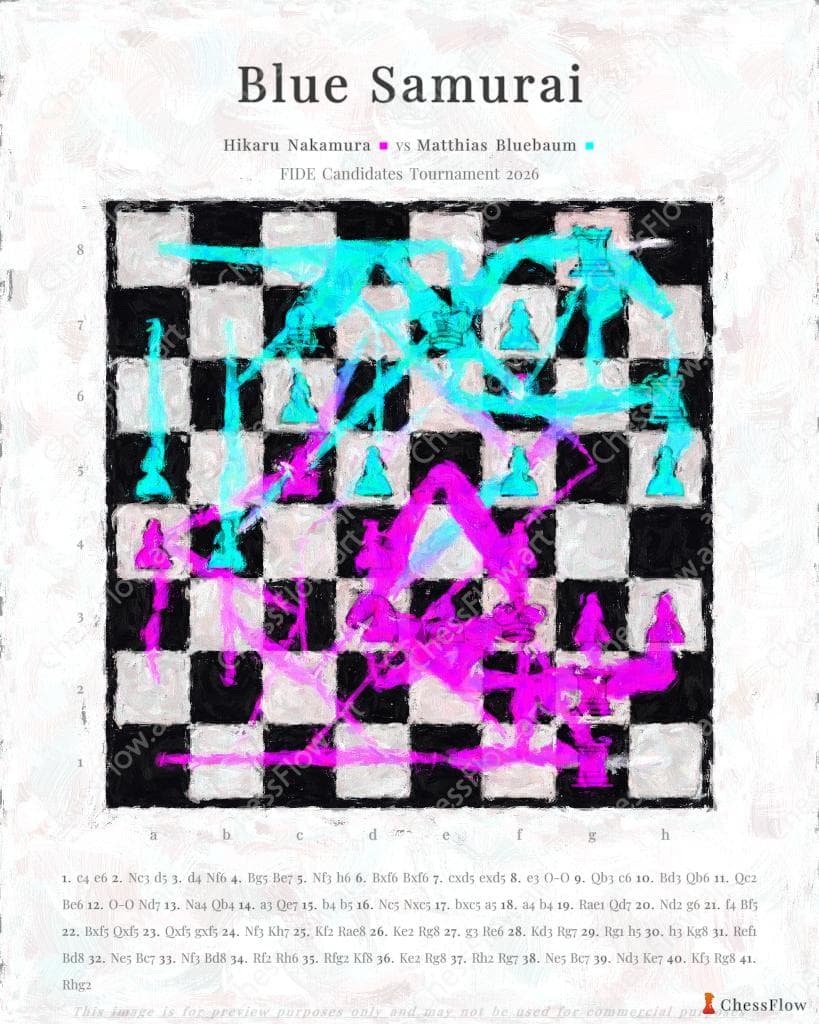
Hikaru Nakamura vs Matthias Bluebaum
Hikaru Nakamura vs Matthias Bluebaum
The Queen's Gambit Declined in Round 13 Hikaru Nakamura and Matthias Bluebaum settled for a draw in round 13 of the 2026 FIDE Candidates Tournament, with Nakamura playing White in a Queen's Gambit De...
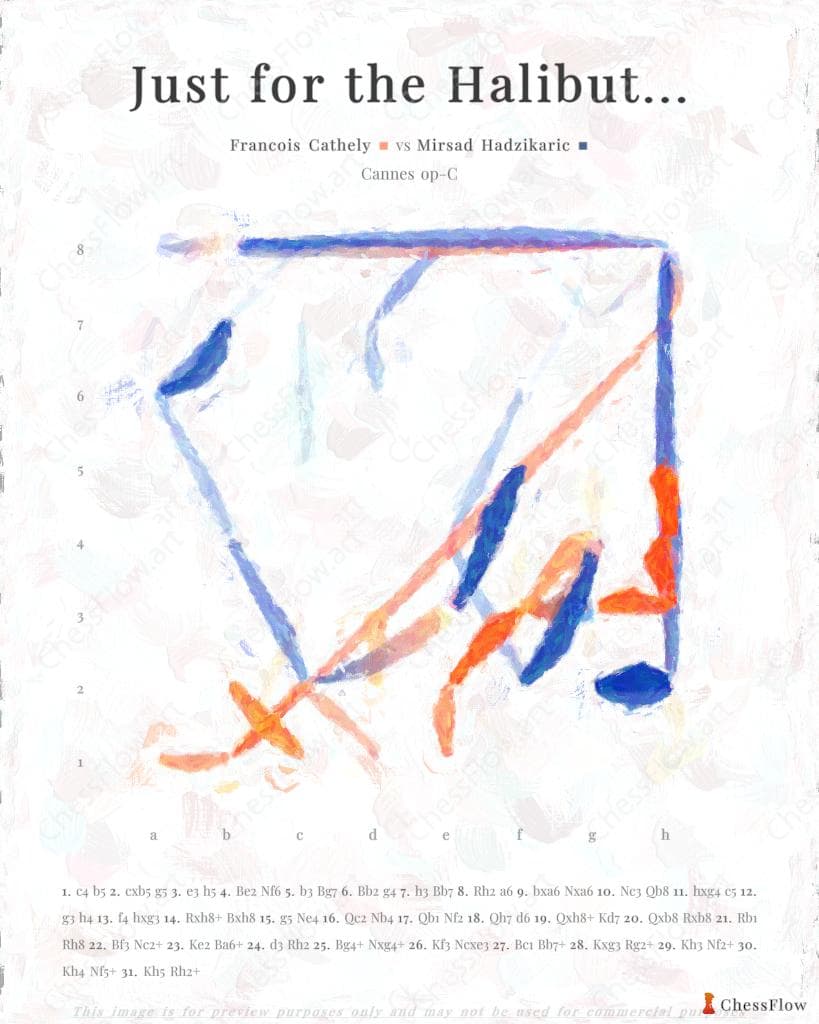
Francois Cathely vs Mirsad Hadzikaric
Francois Cathely vs Mirsad Hadzikaric
The Opening Gambit Francois Cathely and Mirsad Hadzikaric faced off in the 1995 Cannes op-C tournament with an opening that immediately signaled chaos was coming. After 1.c4 b5, Black's Polish Defens...
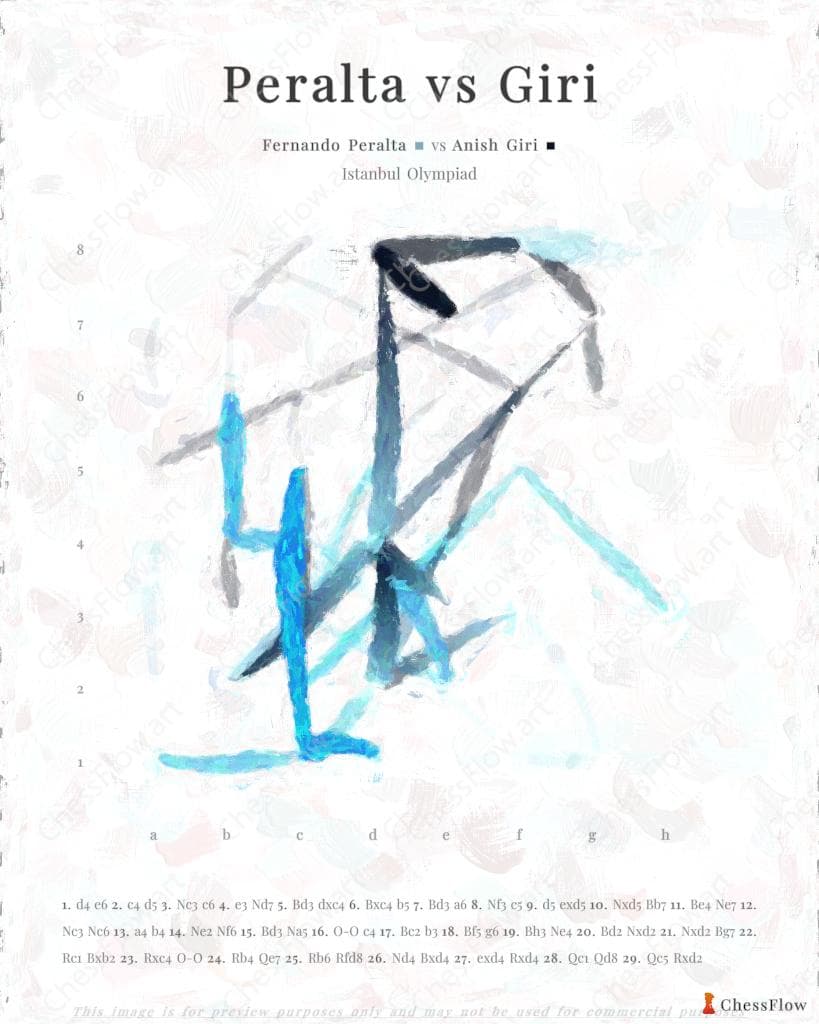
Fernando Peralta vs Anish Giri
Fernando Peralta vs Anish Giri
The Opening Battle Fernando Peralta (2606) faced off against rising Dutch talent Anish Giri (2711) in round 5 of the 2012 Istanbul Olympiad. The game opened with the Queen's Gambit Declined, Semi-Sla...