2026 Norway Chess Women
Koneru Beats Ju Wenjun in Norway Chess Round 10 Armageddon


Queens of the North
Koneru Finds Redemption Against the World Champion
Humpy Koneru entered round ten of Norway Chess Women 2026 in last place with just three points, having lost three Armageddon games already in Oslo. What she needed was a result. What she got was Women's World Champion Ju Wenjun across the board with the white pieces—and this time, Koneru made it count.
The classical game ended in a draw after a Colle System led to early complications, but Koneru took the Armageddon decider to collect 1.5 points and keep her tournament hopes alive. For Ju, it marks another tiebreak loss in a tournament where she's struggled to convert advantages.
The Colle System: A Quiet Opening Turns Sharp
Ju opened with 1.d4 Nf6 2.Nf3 e6 3.e3 d5 4.Bd3 c5 5.c3, steering into the Traditional Colle—a solid, methodical system that aims to build pressure on the kingside while keeping the position closed. It's the kind of opening that doesn't scream for attention but can suffocate opponents who don't find active counterplay.
Koneru responded with the standard setup: 5...Nc6 developing naturally, followed by 6...Bd6 and 7...O-O, completing her development efficiently. The position remained balanced through the first seven moves, with engines showing near-equality throughout.
The game's first real tension came after 8.Qe2, when Koneru struck in the center with 8...e5. This pawn break is thematic in such structures—Black challenges White's d4 pawn and opens lines for her pieces. The position transformed from a quiet Colle into something with genuine middlegame bite.
After 9.dxc5 Bxc5 10.e4, the center opened up completely. Ju was now committed to an open game, which is not typically where the Colle wants to end up. Koneru responded with 10...Bg4, pinning the knight on f3 and creating immediate tactical pressure.
Where Koneru Let the Advantage Slip
The critical moment in the classical portion came after 11.exd5 Qxd5 12.Ne4. Here Koneru faced a decision that would define the middlegame character. The engine preferred 12...Rfd8, keeping the rook active and maintaining central pressure. Instead, Koneru played 12...Be7?!, retreating the bishop to a passive square.
This inaccuracy handed Ju a meaningful edge—the evaluation jumped from +0.38 to over +1.00. The bishop on e7 was no longer participating in the game's central action, and White's knight on e4 became a dominant piece.
Ju continued with 13.h3, forcing the bishop to make another decision. 13...Bh5 kept the pin on the knight, but the piece was now somewhat awkwardly placed. The follow-up 14.Rd1 put pressure on Black's queen, which had to find a new home.
Koneru's choice of 14...Qa5?! was another slip. The queen retreated to the queenside, but 14...Qe6 would have kept better coordination with Black's pieces. After this second inaccuracy, Ju's advantage grew to nearly +1.6 according to the engines—a significant edge at the elite level.
Ju Returns the Favor
But this is where the game took an unexpected turn. With a clear advantage and multiple promising continuations, Ju played 15.Ng3?! instead of the stronger 15.Nxf6+. The knight capture would have damaged Black's pawn structure and maintained White's initiative. Instead, the knight retreated to g3, and Koneru found 15...Bg6, getting her bishop to a better diagonal.
This moment encapsulates something that happens constantly at the highest levels but rarely gets discussed: advantages evaporate. One imprecise move, and Ju's +1.6 edge dropped back to around +0.7. Still better for White, but no longer the kind of position where conversion feels inevitable.
The game continued with both players navigating the complications. Koneru's task was to create enough counterplay to survive, while Ju needed to convert her remaining edge. In classical time controls, this kind of position can grind on for hours—but neither player could find a way to break through, and the game eventually headed toward a draw.
The Armageddon Decider
With the classical game drawn, everything came down to Armageddon—the format that has defined this tournament. In Norway Chess's system, White gets more time but must win; Black only needs a draw. It's a format that creates genuine tension and has produced several dramatic finishes in Oslo.
For Koneru, Armageddon had been unkind throughout the event. She'd lost three straight tiebreakers entering this round, including a painful defeat to Bibisara Assaubayeva where she blundered her queen with one second left on the clock before move 45. That loss—where 45.Kg1 would have held but 45.Kf3?? lost by force to 45...Ne5+—had been the low point of her tournament.
Against Zhu Jiner in round four, Koneru admitted the problem wasn't just the position: "I just played and I started blundering all of a sudden." She identified her mistake clearly: "Probably I should have played h5 instead of b4. b4 was just too stupid because once she got this ...d4 and ...Bf8 my king got open completely."
But against Ju, Koneru finally got the result she needed. The tiebreaker gave her the 1.5 points that keeps her in mathematical contention. With the Norway Chess scoring system—where a classical win is worth three points and an Armageddon win is worth 1.5—a single classical victory can still dramatically shift the standings.
Tournament Implications
Bibisara Assaubayeva continues to lead the event with seven points after beating Ju in Armageddon earlier in the tournament. The Kazakh player remains the only competitor to have scored a classical win, which she achieved against Koneru in round one. Behind her, Anna Muzychuk, Zhu Jiner, and Divya Deshmukh are all within striking distance.
For Ju Wenjun, the tournament has been a struggle. The Women's World Champion has now lost multiple Armageddon games and sits in the middle of the pack. Her technique has faltered under time pressure repeatedly—against Deshmukh, she dropped a queen in the tiebreaker; against Zhu, she couldn't convert a winning position once her clock dropped below 30 seconds.
Koneru's path forward is narrow but not impossible. "Every player is still in contention to win the event," as the tournament coverage noted, and a classical win in the remaining rounds could change everything. The position after move 14 in this game—with Koneru's queen awkwardly placed and Ju's centralized knight dominating—is the kind of tense moment that makes these encounters worth following. We turned this one into a print.
The Colle's Limitations Exposed
One tactical note worth examining: the Colle System gave Ju a comfortable position out of the opening, but it didn't generate the kind of winning chances she needed. After Koneru's 8...e5 break, the position opened up in a way that favored Black's active piece play.
The opening choice itself might be questioned. Against a player fighting for survival in the standings, something sharper might have created more practical problems. The Colle is a system that relies on slow maneuvering and gradual pressure—but when your opponent is desperate for counterplay, giving them a clear plan (...e5, challenge the center, activate pieces) can backfire.
Ju's 10.e4 was ambitious, but it also meant accepting an open position where both players had chances. The engine evaluation stayed close to equal for most of the opening phase, which is exactly what Koneru needed—a fighting game where mistakes on both sides were possible.
Looking Ahead
Six rounds remain in Norway Chess Women 2026, and the standings remain remarkably tight. Assaubayeva's lead is solid but not insurmountable. Koneru's win over Ju proves that even the player in last place can take points from the world champion on any given day.
The format rewards aggression—players who push for classical wins get three points, while those who settle for Armageddon battles split 1.5 and 1. Koneru knows this better than anyone. Her three Armageddon losses have cost her dearly, but one classical victory would put her right back in contention.
For Ju, the question is whether she can find her form before the tournament ends. She's been close to winning several games but has consistently failed to convert under time pressure. At 2559, she's the highest-rated player in the field, but ratings don't win Armageddon games—clock management and nerve do.
The next round brings new pairings and new opportunities. In a tournament where no classical game has been decisive since round one, someone is due for a breakthrough. Whether it's Koneru climbing out of last place or Assaubayeva extending her lead, Norway Chess Women 2026 remains wide open.
1.d4 Nf6 2.Nf3 e6 3.e3 d5 4.Bd3 c5 5.c3 Nc6 6.Nbd2 Bd6 7.O-O O-O 8.Qe2 e5 9.dxc5 Bxc5 10.e4 Bg4 11.exd5 Qxd5 12.Ne4 Be7 13.h3 Bh5 14.Rd1 Qa5 15.Ng3 Bg6 16.Bxg6 hxg6 17.b4 Qc7 18.b5 Na5 19.Qxe5 Qxe5 20.Nxe5 Rac8 21.Bd2 Rc5 22.f4 Rfc8 23.Rab1 Nc4 24.Nxc4 Rxc4 25.Ne2 Ne4 26.Be1 Bf6 27.Rd7 Nc5 28.Rdd1 Ne4 29.Rb3 Nxc3 30.Bxc3 Bxc3 31.Nxc3 Rxc3 32.Rxc3 Rxc3 33.Rd8+ Kh7 34.Rd7 f6 35.Rxb7 Ra3 36.Kh2 Rxa2 37.Kg3 Ra4 38.Kf3 Ra2 39.h4 f5 40.g3 Ra3+ 41.Kf2 Kh6 42.Kg2 Kh7 43.Kf2 Kh6 44.Kg2 Kh7 45.Kh3 Ra2 46.Rc7 Ra5 47.Rb7 Ra2 48.Rb8 Rb2 49.h5 gxh5 50.Kh4 Kg6 51.Kh3 Ra2 0-1
How would it look as art?


Own a piece of chess history. Transform this legendary game into a unique piece of art for your home or office.
Perfect For
- Unique Gifts for chess enthusiasts and players
- Tournament Prizes that winners will treasure
- Club Decor for chess clubs and gaming spaces
- Office Art showcasing strategic thinking
- Personal Collection of historic games
Turn Your Games Into Art
Whether it's your own game from Chess.com or Lichess, or another historic masterpiece, transform any chess game into a stunning visual artwork.
You might also like
More legendary chess game stories
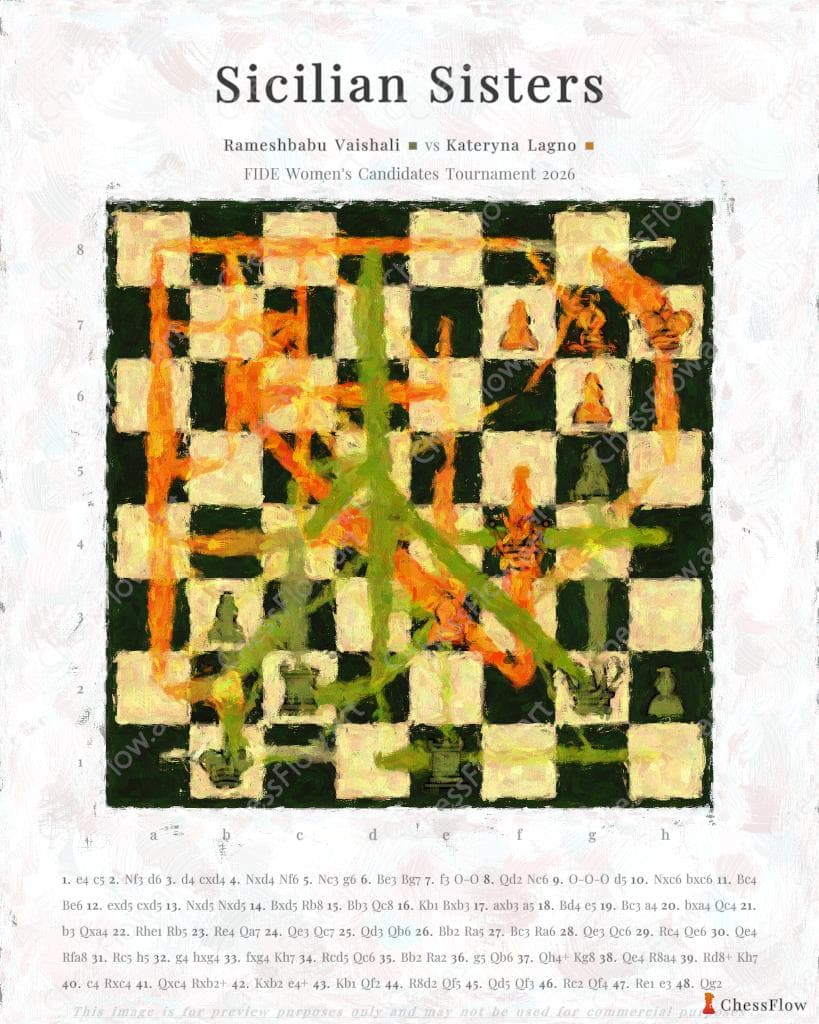
Rameshbabu Vaishali vs Kateryna Lagno
Rameshbabu Vaishali vs Kateryna Lagno
Vaishali Strikes in the Dragon Vaishali Rameshbabu defeated Kateryna Lagno in round 14 of the FIDE Women's Candidates Tournament 2026, playing a sharp Sicilian Dragon that ended in White's favor. The...

Nodirbek Abdusattorov vs Jorden Van Foreest
Nodirbek Abdusattorov vs Jorden Van Foreest
A Quiet Day in Malmö Nodirbek Abdusattorov and Jorden van Foreest split the point in round 7 of the TePe Sigeman Chess Tournament 2026, a game that never really caught fire. The Grünfeld Defense led...
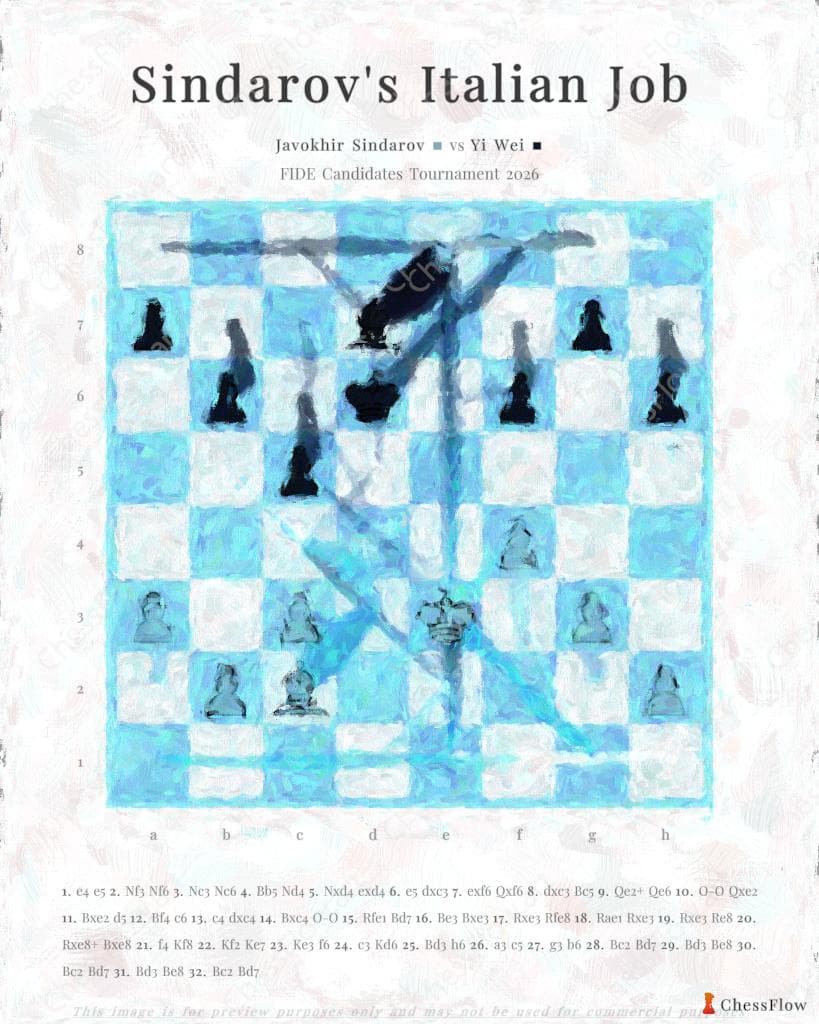
Javokhir Sindarov vs Yi Wei
Javokhir Sindarov vs Yi Wei
The Opening Javokhir Sindarov and Yi Wei opened round 14 of the 2026 FIDE Candidates Tournament with the Four Knights Game, specifically the Spanish Variation, Rubinstein Variation Accepted (ECO C48)...