Sardinia World Chess Festival 2026 | Open A
Karthikeyan Defeats Jacobson in Sardinia Round 7 Scotch

Sardinian Sunset
Karthikeyan Grinds Down Jacobson in Round 7 Scotch
Murali Karthikeyan picked up a crucial win in Round 7 of the Sardinia World Chess Festival 2026, defeating Brandon Jacobson in a Scotch Game that slowly tilted in White's favor before collapsing entirely for the American. The Indian GM, rated 2648, used patient maneuvering and a well-timed exchange on e6 to create lasting structural damage that Jacobson couldn't repair.
The result moves Karthikeyan into a strong position heading into the final two rounds of this nine-round Swiss, while Jacobson—who had drawn Ian Nepomniachtchi in Round 4—will need to regroup quickly. In a field featuring the former World Championship challenger and a host of 2600+ GMs, every full point carries enormous weight for FIDE Circuit standings.
A Rare Scotch Sideline
The game began with 1.e4 e5 2.Nf3 Nc6 3.d4 exd4 4.Nxd4, entering the Scotch Game. But Jacobson immediately steered away from the main lines with 4...Qf6, an early queen sortie that aims to put pressure on d4 while keeping options open. It's a sideline you don't see at the top level every day—most players prefer 4...Nf6 or 4...Bc5—but it has its logic: the queen eyes both the d4-knight and the f2-pawn, and Black hopes to develop quickly while White figures out how to consolidate.
Karthikeyan responded calmly with 5.Nf3, retreating the knight rather than defending it with Be3 or Nb3. This practical choice sidesteps any tactical tricks and prepares to simply develop. After 5...Bb4+ 6.c3 Bc5 7.Be2, we had a position where White has a slight space advantage and the bishop pair in prospect, but nothing dramatic. The engines hover around +0.25, the kind of edge that means "White is comfortable" rather than "White is winning."
The early middlegame unfolded slowly. Jacobson played 7...d6 and 8...Nge7, a slightly passive setup that keeps everything solid but doesn't fight for the initiative. Karthikeyan continued developing with 8.Nbd2 and 9.Nc4, eyeing the d6-pawn and the a5-square. Jacobson's 9...a5 was a reasonable response, preventing Na5 ideas and giving the bishop a potential retreat square, but it also created a small weakness on b5.
The Exchange on e6 Changes Everything
The critical moment came after both sides castled. Jacobson had played 10...Be6, developing his last minor piece and preparing to connect rooks. Karthikeyan responded with 11.Ng5, putting immediate pressure on the bishop. This is a typical idea in such positions—the knight on g5 combined with the knight on c4 creates an awkward situation for Black's light-squared bishop.
Jacobson castled with 11...O-O, and then Karthikeyan played the prophylactic 12.Kh1. This quiet move gets the king off the g1-a7 diagonal (relevant if Black ever plays ...d5) and prepares f2-f4 ideas without worrying about back-rank issues. It's the kind of move that looks like nothing but actually shows deep understanding of the position's requirements.
Then came 12...b5, and this is where the evaluation starts to shift. The move looks active—Jacobson is pushing on the queenside, challenging the c4-knight—but it also loosens the position. Engines immediately tick up to +0.63, not because Black is losing, but because the pawn structure is about to become problematic.
Karthikeyan struck with 13.Nxe6 fxe6, and suddenly the position has transformed. Black now has doubled e-pawns, an exposed king with the f-file half-open, and a bishop on c5 that looks nice but doesn't have a clear purpose. White's advantage is structural and permanent. The engines say +0.55, but this is one of those positions where the human experience is much worse than the computer assessment suggests.
The Pawn Break and Its Consequences
After 14.Ne3, Karthikeyan rerouted the knight to a beautiful square where it eyes both d5 and f5. Jacobson continued his queenside play with 14...b4, trying to open lines and create counterplay before White's positional grip becomes suffocating. The move is committal—once you push b4, you're betting everything on queenside activity.
15.Qc2 was Karthikeyan's response, a flexible move that connects the rooks, eyes the c-file, and prepares to meet ...bxc3 with bxc3, keeping the pawn structure intact while opening the b-file for the rook. Jacobson went ahead with 15...bxc3, and here the game enters a phase where White's advantage is clear but converting requires precision.
The position after the pawn exchange is instructive. White has the bishop pair, a better pawn structure (Black's doubled e-pawns are weak and the a5-pawn is isolated), and more space. Black has some piece activity and the half-open b-file, but no clear plan to improve. Engines still say the position is only +0.6 or so, but try defending this for 30 moves with the clock ticking. The practical difficulties are enormous.
This is where the gap between engine assessment and human experience becomes stark. A computer sees that Black can hold with perfect defense. A human sees that every move requires precision, that White can simply improve piece by piece while Black waits, and that one slip means a lost endgame. Jacobson had to find accurate moves for the next several hours while Karthikeyan could probe without significant risk.
The Slow Squeeze
What followed was a textbook demonstration of how to convert a small structural advantage. Karthikeyan didn't rush, didn't overpress, didn't give Jacobson any tactical chances to muddy the waters. He simply improved his pieces, controlled the open files, and waited for the position to crack.
The doubled e-pawns were a constant liability. They couldn't advance without creating new weaknesses, and they required constant protection. The bishop on c5, which looked active in the opening, became a passive defender. Meanwhile, Karthikeyan's pieces found ideal squares: knights on e3 and later d5, bishops controlling long diagonals, rooks on open files.
This kind of chess isn't flashy. There are no sacrifices, no strong combinations, no moments where the crowd gasps. But it's incredibly effective, and it's how strong players win against other strong players. You create a small advantage, you maintain it, you probe for weaknesses, and eventually your opponent cracks under the pressure.
Jacobson, to his credit, defended resourcefully for a long time. But the position was simply too difficult to hold. When you're defending an inferior structure against a player at this level, the margin for error is razor-thin. One inaccuracy, one moment of imprecision, and the advantage becomes decisive.
Tournament Implications
The win is significant for Karthikeyan's tournament standing. The Sardinia World Chess Festival, now in its third edition, has become one of the premier open events in Italy, and this year's field is the strongest yet. With Nepomniachtchi (2729), Parham Maghsoodloo (2710), Ivan Šarić (2657), and a host of other 2600+ players competing, every point matters for both prize money and FIDE Circuit standings.
For Jacobson, rated 2594, the loss stings but isn't catastrophic. He had a solid tournament up to this point, including that draw against Nepomniachtchi in Round 4—no small feat against a former World Championship challenger. Two rounds remain, and a strong finish is still possible.
The game also highlights the importance of structural play at the top level. Jacobson's opening wasn't bad, and he didn't make any obvious blunders. But the exchange on e6 created lasting problems that proved impossible to solve over the board. Sometimes chess isn't about strong tactics or deep calculations—it's about understanding which positions are easier to play and steering toward them.
The position after move 13, with those doubled e-pawns staring back at Black, is the kind of thing you study to understand why pawn structure matters. We turned this one into a print—sometimes the most instructive games are the quiet ones.
With two rounds remaining in Sardinia, the race for first place is wide open. Fourteen players were tied at 3.5/4 after Round 4, and the pack hasn't thinned much since. Karthikeyan's win keeps him in contention, while Jacobson will need to bounce back quickly. The final rounds promise more drama as players fight for prize money, rating points, and FIDE Circuit standings in one of the most beautiful chess venues in the world.
The Sardinia World Chess Festival continues through May 10, with Round 8 scheduled for May 9 and the final round on May 10. Follow the action live on Lichess or check the official tournament page for standings and pairings.
1.e4 e5 2.Nf3 Nc6 3.d4 exd4 4.Nxd4 Qf6 5.Nf3 Bb4+ 6.c3 Bc5 7.Be2 d6 8.Nbd2 Nge7 9.Nc4 a5 10.O-O Be6 11.Ng5 O-O 12.Kh1 b5 13.Nxe6 fxe6 14.Ne3 b4 15.Qc2 bxc3 16.bxc3 d5 17.exd5 exd5 18.Rb1 Rae8 19.Rb5 Qd6 20.Bd3 h6 21.Qd1 Ne5 22.Bc2 Ra8 23.f4 Nd7 24.Ng4 c6 25.Rb7 Nf5 26.Re1 Rab8 27.Rxb8 Qxb8 28.Bxf5 1-0
How would it look as art?


Own a piece of chess history. Transform this legendary game into a unique piece of art for your home or office.
Perfect For
- Unique Gifts for chess enthusiasts and players
- Tournament Prizes that winners will treasure
- Club Decor for chess clubs and gaming spaces
- Office Art showcasing strategic thinking
- Personal Collection of historic games
Explore more
Turn Your Games Into Art
Whether it's your own game from Chess.com or Lichess, or another historic masterpiece, transform any chess game into a stunning visual artwork.
You might also like
More legendary chess game stories

Jiner Zhu vs Aleksandra Goryachkina
Jiner Zhu vs Aleksandra Goryachkina
Goryachkina Takes Down Zhu in Round 13 Aleksandra Goryachkina scored a crucial victory over Jiner Zhu in round 13 of the FIDE Women's Candidates Tournament 2026, dealing a blow to the Chinese GM's ch...
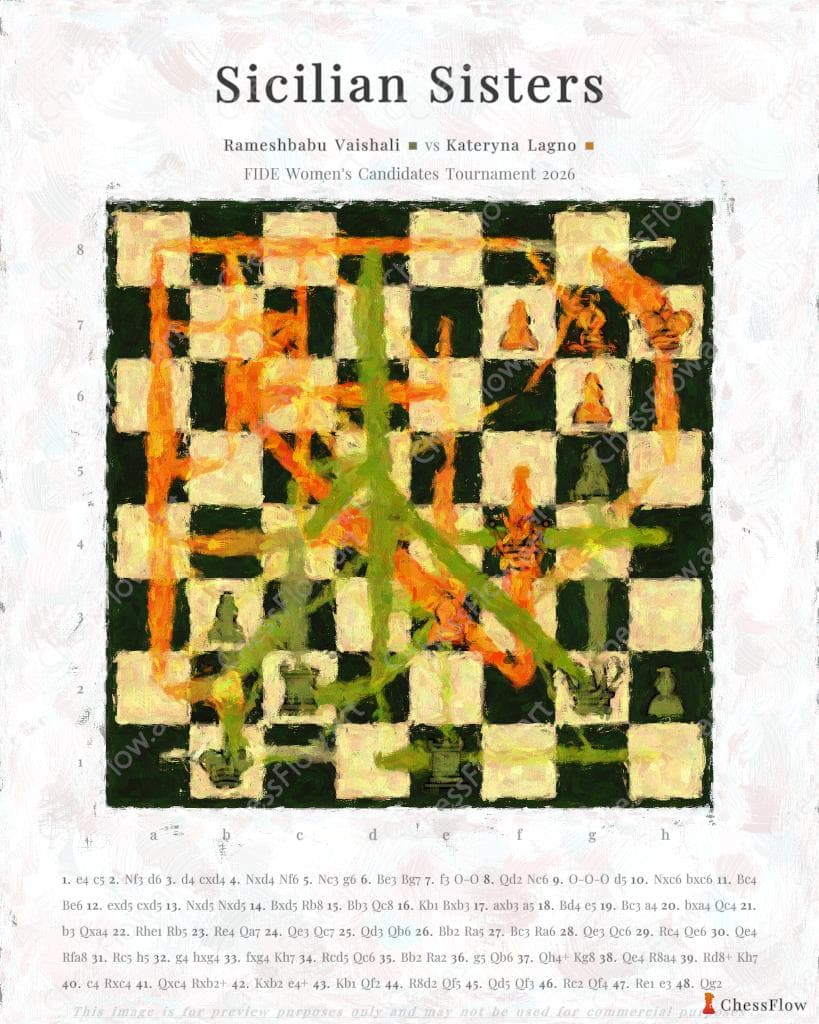
Rameshbabu Vaishali vs Kateryna Lagno
Rameshbabu Vaishali vs Kateryna Lagno
Vaishali Strikes in the Dragon Vaishali Rameshbabu defeated Kateryna Lagno in round 14 of the FIDE Women's Candidates Tournament 2026, playing a sharp Sicilian Dragon that ended in White's favor. The...
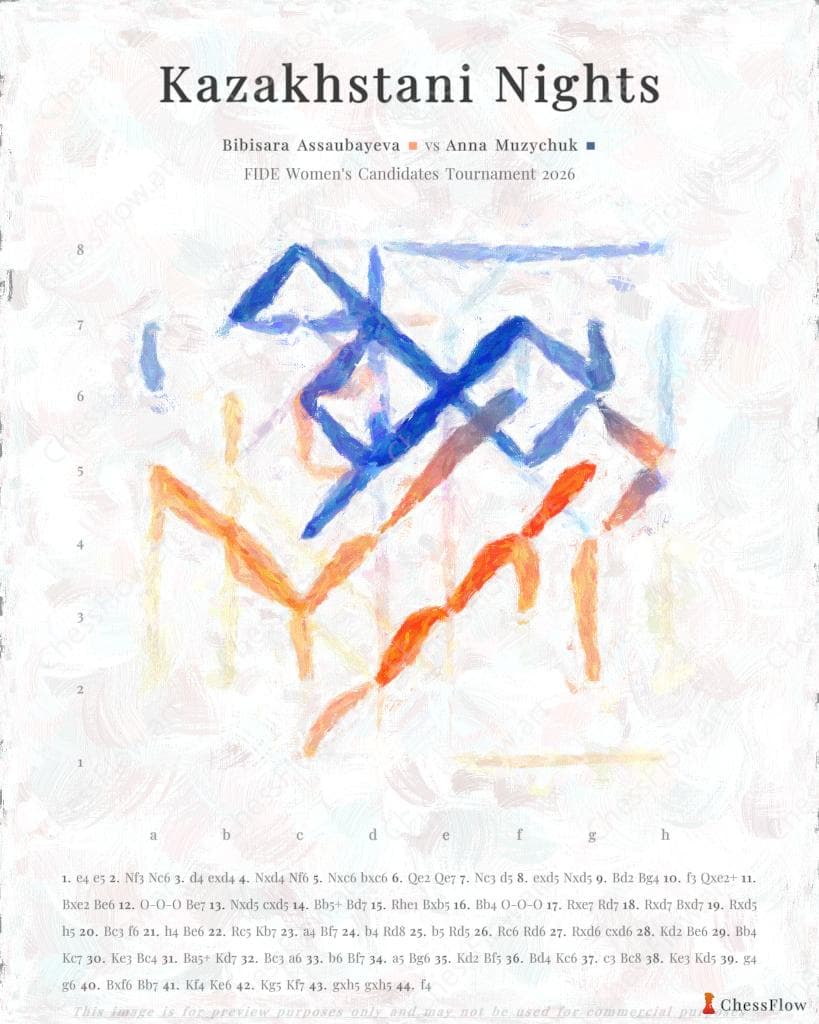
Bibisara Assaubayeva vs Anna Muzychuk
Bibisara Assaubayeva vs Anna Muzychuk
Assaubayeva Strikes Back in Round 13 Bibisara Assaubayeva bounced back from recent struggles to defeat Anna Muzychuk in round 13 of the FIDE Women's Candidates Tournament 2026. The Kazakhstani GM, ra...