Sardinia World Chess Festival 2026 | Open A
Puranik Draws Maghsoodloo in 15-Move Slav at Sardinia 2026


Puranik's Meridian
A Solid Draw in Sardinia
Abhimanyu Puranik and Parham Maghsoodloo split the point in round 8 of the Sardinia World Chess Festival 2026, a 15-move draw that reflected both players' pragmatic approach in a tournament where FIDE Circuit points carry real weight. The game, played in the Slav Defense's Soultanbeieff Variation, never left the realm of theoretical equality before the players agreed to peace.
For Puranik, rated 2607, this was a chance to test himself against the tournament's second seed. Maghsoodloo, at 2710, came into the game having already navigated a tricky tournament — including a surprising first-round draw against FM Massimiliano Botta, rated just 2270. Neither player seemed interested in burning energy in a position that offered little to either side.
The Opening: Slav Soultanbeieff
The game opened with 1.d4 d5 2.c4 c6 3.Nf3 Nf6 4.Nc3 dxc4 5.a4 e6 6.e3 c5, entering the Soultanbeieff Variation of the Slav Defense. This line has a reputation for solidity — Black gives up the c4 pawn temporarily but gets active piece play and a flexible structure in return. Maghsoodloo, who at the 2025 Grand Swiss said "I think most of the guys I see they try to win very hard and it bounces back and they lose. It's not the tournament to risk it all for one game!", seemed content to steer into well-charted waters.
7.Bxc4 recaptured the pawn, and after 7...Nc6 8.O-O cxd4 9.exd4, we reached an Isolated Queen's Pawn (IQP) structure — one of the most studied formations in chess. White gets active pieces and central control; Black gets a clear target on d4 and the prospect of a favorable endgame if pieces come off.
The position after 9...Be7 10.Be3 O-O was completely standard. Both sides had castled, developed naturally, and the engines showed evaluations hovering around +0.2 to +0.3 — essentially nothing. This is the kind of position where a 2700+ player knows every idea, every plan, every typical maneuver. The question becomes: who wants to deviate first, and at what cost?
Puranik Probes with Ne5
Puranik tried to generate some activity with 11.Ne5, a thematic move in IQP positions. The knight on e5 is aggressively placed, supporting potential kingside operations and controlling key squares. It's the kind of move that asks Black: do you want to challenge this immediately, or let me build?
Maghsoodloo responded with 11...Nb4, hopping his knight to an active square where it eyes both d5 and c2. This is a standard idea — Black's knight on b4 is annoying for White, and it prepares ...Nbd5 to challenge the central knight.
Puranik continued with 12.Qf3, sliding the queen to an active diagonal where it supports potential kingside play and keeps an eye on the d5 square. The position was still theoretical, still balanced, but at least both players were making commitments.
After 12...a6 13.Rfd1, Puranik brought his last piece into the game. The rook on d1 supports the isolated d4 pawn and prepares for any central action. Maghsoodloo responded with 13...Nfd5, a logical move that challenges White's knight on e5 indirectly by putting pressure on the bishop on e3.
The Critical Juncture
The position after 14.Bb3 Rb8 15.Qg3 represented the high-water mark of complexity in this game. Puranik's queen on g3 eyes the kingside, and there's a hint of aggression — the queen could support f4-f5 ideas in some lines, or simply keep Black honest about kingside weaknesses.
But here's the thing about IQP positions at the grandmaster level: both players know the theory, both players know the typical plans, and both players know that a single inaccuracy can be punished. The evaluation never exceeded +0.76 at any point in the game, and that came after 13...Nfd5 — hardly a position where White can claim a meaningful advantage.
Engines might say +0.5, but humans know better. In a position like this, with plenty of pieces on the board and no clear plan for either side to make progress, the practical chances are roughly equal. Neither player has a weakness to attack, neither has a space advantage, and neither has the kind of dynamic imbalance that leads to decisive games.
The draw was agreed here, after just 15 moves. Some might call it short, but there's a logic to it. With FIDE Circuit points on the line and eight rounds of chess already played, neither player saw a reason to grind out 40 more moves in a position that was going nowhere.
Context: The Tournament Situation
This draw fits into the broader context of the Sardinia World Chess Festival 2026, which has been a battleground for FIDE Circuit points. The tournament, held at the Club Hotel Marina Beach in Orosei, features a €50,100 prize fund and a field headlined by Ian Nepomniachtchi (2729), with Maghsoodloo as the second seed.
Puranik entered round 8 having been part of the early tournament leaders — he was among those sharing the lead with Nepomniachtchi after the first few rounds, alongside Murali Karthikeyan, Leon Luke Mendonca, and Prraneeth. A draw against a higher-rated opponent is never a bad result, especially when you're trying to maintain position in a crowded field.
For Maghsoodloo, this was another half-point in what has been a steady but unspectacular tournament. His first-round draw against the 2270-rated Botta was a shock, but he's since recovered. The Iranian GM, who led the 2025 Grand Swiss at one point, knows how to manage these events. As he said after that tournament, the key is not to overpress.
The Soultanbeieff: A Brief Primer
For those less familiar with the opening, the Soultanbeieff Variation (ECO D16) arises after 1.d4 d5 2.c4 c6 3.Nf3 Nf6 4.Nc3 dxc4 5.a4 e6. The move 5...e6 is the defining characteristic — Black supports the c4 pawn and prepares ...c5, striking at White's center.
The resulting positions often transpose into IQP structures, as happened in this game. White gets the isolated d4 pawn but also gets active pieces and central control. Black's task is to neutralize White's activity and eventually target the d4 weakness.
This variation has been played at the highest levels for decades. It's not a fighting opening in the sense at this level.
What This Game Tells Us
Not every game needs to be a bloodbath. The Puranik-Maghsoodloo draw is a reminder that professional chess at the open tournament level often involves careful risk management. Both players have rating points to protect, both have FIDE Circuit aspirations, and both understand that a draw with Black against a lower-rated opponent (for Maghsoodloo) or a draw with White against a higher-rated opponent (for Puranik) is a perfectly acceptable outcome.
The game also illustrates the depth of modern opening preparation. Both players clearly knew the theory, both played quickly through the opening phase, and both reached a position where neither saw a reason to deviate from the main lines. This is the reality of chess in 2026 — at the GM level, the opening is often a matter of choosing your battlefield rather than trying to outprepare your opponent in every line.
Looking Ahead
With round 8 complete, the Sardinia World Chess Festival moves into its final stages. The tournament has already produced some drama — Nepomniachtchi's presence alone guarantees attention, and the FIDE Circuit implications mean every half-point matters.
For Puranik, who at 2607 is one of the stronger Indian GMs on the circuit, this tournament represents an opportunity to gain rating points and Circuit standing. For Maghsoodloo, it's about maintaining his position among the world's elite and continuing his push toward the Candidates Tournament 2028.
The position after move 15 in this game — with that knight on e5 and the queen on g3 — has a certain geometric appeal. We turned this one into a print.
The Sardinia World Chess Festival continues through May, with the final rounds promising more action as players jockey for position in the standings. Whether we'll see more fighting chess or more pragmatic draws remains to be seen, but with Nepomniachtchi, Maghsoodloo, and a host of strong GMs still in contention, there's plenty of chess left to play.
Follow along on ChessFlow for more coverage of the Sardinia World Chess Festival 2026 and other top-level events.
1.d4 d5 2.c4 c6 3.Nf3 Nf6 4.Nc3 dxc4 5.a4 e6 6.e3 c5 7.Bxc4 Nc6 8.O-O cxd4 9.exd4 Be7 10.Be3 O-O 11.Ne5 Nb4 12.Qf3 a6 13.Rfd1 Nfd5 14.Bb3 Rb8 15.Qg3 Bh4 16.Qg4 Nxe3 17.fxe3 Nd5 18.Qe4 Nxc3 19.bxc3 Bf6 20.Rf1 b5 21.Bc2 g6 22.Nc6 Bb7 23.axb5 axb5 24.Nxd8 Bxe4 25.Nxe6 fxe6 26.Bxe4 Bg5 27.Rfe1 Rfc8 28.Ra3 b4 29.cxb4 Rxb4 30.Bf3 Kg7 31.Kf2 Kh6 32.Ra5 Re8 33.Re5 Bh4+ 34.g3 Bf6 35.Re4 Rb5 36.Rd1 Rb2+ 37.Kg1 e5 38.d5 Rf8 39.Bg4 Bd8 40.Rxe5 Rff2 41.Bh3 Rxh2 42.Bf1 Rhf2 43.d6 Rf3 44.Re8 Rxg3+ 45.Kh1 Rg5 1/2-1/2
How would it look as art?


Own a piece of chess history. Transform this legendary game into a unique piece of art for your home or office.
Perfect For
- Unique Gifts for chess enthusiasts and players
- Tournament Prizes that winners will treasure
- Club Decor for chess clubs and gaming spaces
- Office Art showcasing strategic thinking
- Personal Collection of historic games
Explore more
Turn Your Games Into Art
Whether it's your own game from Chess.com or Lichess, or another historic masterpiece, transform any chess game into a stunning visual artwork.
You might also like
More legendary chess game stories
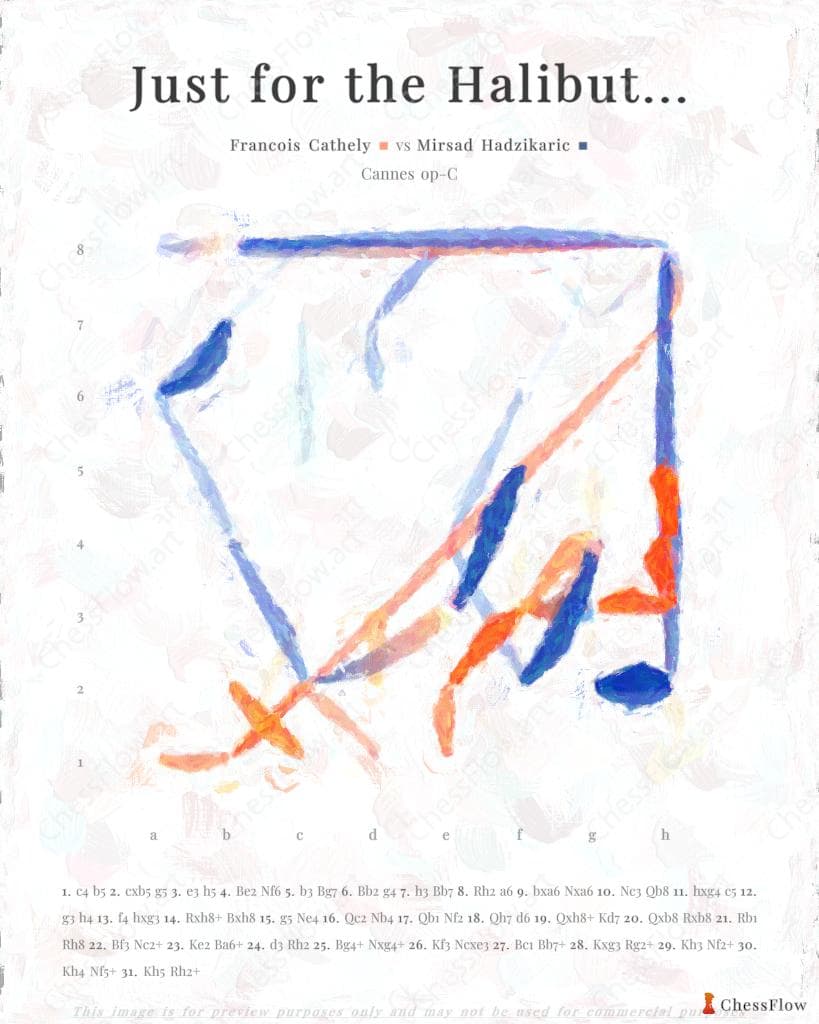
Francois Cathely vs Mirsad Hadzikaric
Francois Cathely vs Mirsad Hadzikaric
The Opening Gambit Francois Cathely and Mirsad Hadzikaric faced off in the 1995 Cannes op-C tournament with an opening that immediately signaled chaos was coming. After 1.c4 b5, Black's Polish Defens...
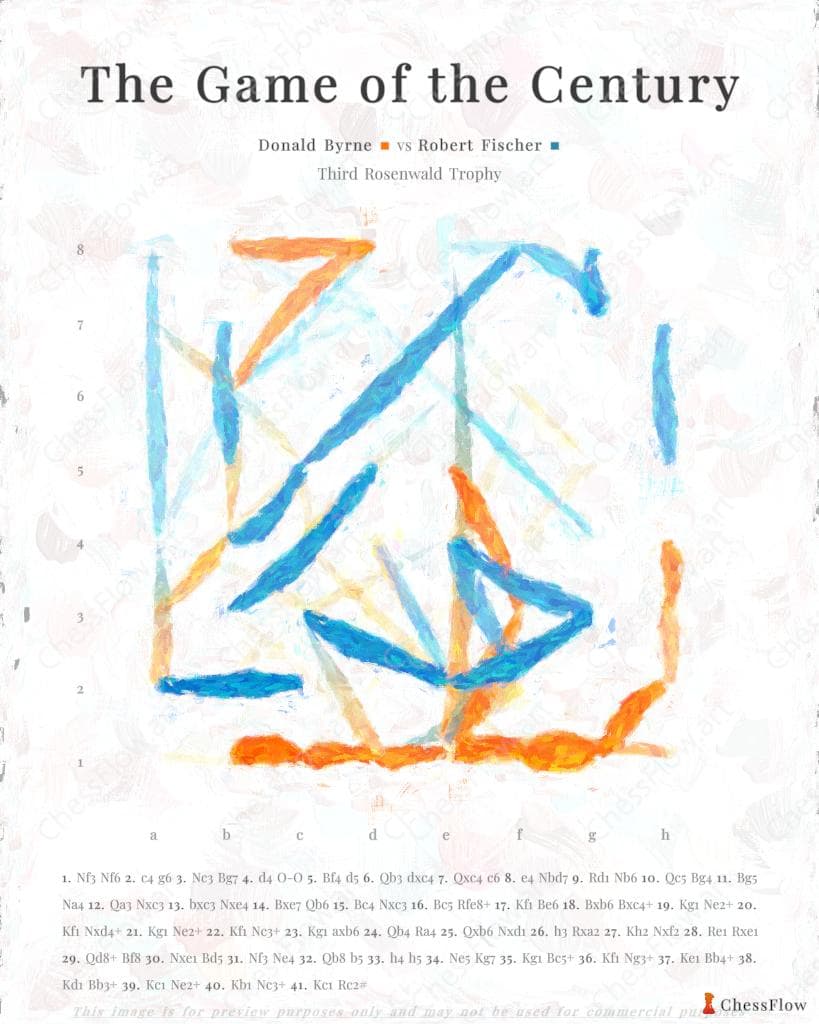
Donald Byrne vs Robert Fischer
Donald Byrne vs Robert Fischer
On the evening of October 17, 1956, inside New York’s Marshall Chess Club, a 13-year-old Bobby Fischer conjured a queen sacrifice so audacious that Chess Review editor Hans Kmoch immediately christene...
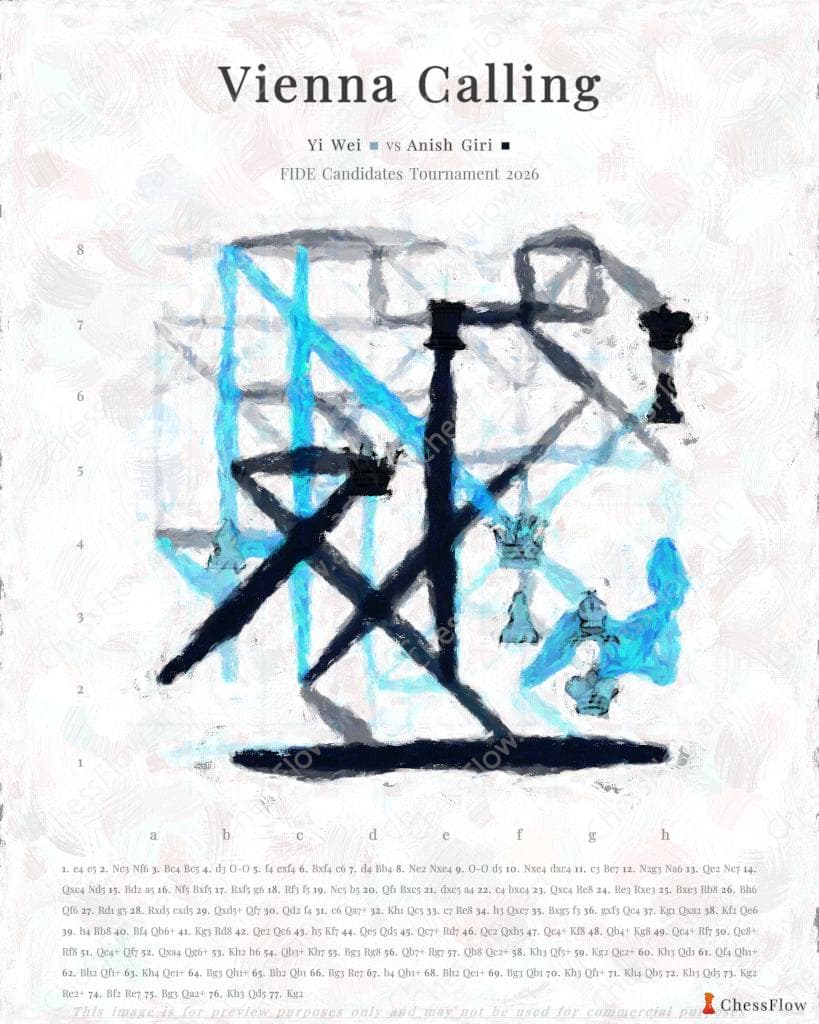
Yi Wei vs Anish Giri
Yi Wei vs Anish Giri
The Vienna Hybrid Experiment Wei Yi's choice of the Vienna Hybrid against Anish Giri in round 12 of the 2026 FIDE Candidates raised eyebrows. The opening sequence 1.e4 e5 2.Nc3 signals White's intent...