A famous game, painted
The Evergreen Game: Anderssen vs Dufresne, 1852
Casual game, Berlin (place usually assumed)
The queen sacrifice 21.Qxd7+ sets up a double check and mate on move 24; an 1879 remark by Steinitz gave the game its name.
The picture is made from the moves of the game by our own painting algorithm. Not AI-generated, not painted by hand. How it’s painted
€89delivery included
Style
Sails
Each move that decided the game is a sail of colour, and the quiet moves that counted most are fine threads. Where two sails cross, the colours deepen.
Framed from €69 · poster from €25 · file €15
Colours
Earth: terracotta and moss green
Format and size
Matte paper behind clear acrylic in a wooden frame. Ready to hang.
Sails is flat colour and fine lines, which print sharpest on smooth paper. So it is made on paper, not canvas.
Frame
We would pick the white frame for this look. Oak is made at 30 × 40 cm only.
€89, delivery included. Arrives 27 Nov – 5 Dec in Europe and the US.
Final price. No VAT is charged: small business under § 19 UStG.
Pay by card, Google Pay or, in most euro countries, Klarna.
If it arrives damaged or printed wrong, send us a photo within 30 days and we reprint it or refund you.
A print of a famous game can also be returned within 14 days of delivery. Shipping and returns
Print-ready file includedFree with every print until 24 December. Emailed as soon as you pay: something to show before the parcel arrives.
Product safety. Manufacturer: Fabrizio Spadaro (ChessFlow), Dietrich-Bonhoeffer-Straße 4A, 10407 Berlin, Germany, hello@chessflow.art.
Product: Framed print, 40 × 50 cm (15.7 × 19.7 in) inside a white frame, ref. framed-medium.
Hang it from a screw or hook that suits your wall and holds the frame’s weight.
Want your own title, names or colours on it? Make this game your own.
Sails, Earth · Framed, 40 × 50 cm · delivery included
How to read this painting
The painting comes in three styles, and each is read in its own way. The numbers below come from the moves themselves, so you can check them against the picture.
- Sails
- White’s moves are in one family of colours and Black’s in the other. Each move that decided the game is a sail: its straight edge runs from the square a piece left to the square it reached. The quiet moves that counted most are fine threads between their two squares.
- Gesture
- White’s moves are in one colour and Black’s in the other. Every move is a line from the square a piece left to the square it reached, bowed for a knight. The moves that decided the game are brushed in full ink, the wider the stroke the heavier the piece, and a pressed dab marks a capture. The few moves just below them are pale washes. Every other move is a charcoal line, firmer the more it counted.
- Facets
- Each line is one of the moves that decided the game, carried on across the board. A plane is painted where a move was played along it, in White’s colour or in Black’s, deepest where the move counted most; the rest of the board stays bare paper. Whoever won holds the larger part.
- Moves painted
- 47: 24 by White, 23 by Black
- Longest move
- White’s rook, e1 to e7 (20.Rxe7+)
- Busiest square
- f6, landed on 4 times
- Furthest traveller
- White’s bishop from f1: 11 squares
- Captures
- 12, painted more boldly than quiet moves
- Knight moves
- 7, the bent strokes
- Distance moved
- White 60%, Black 40% of all the squares travelled
- Castling
- White on move 7, Black never
- Last move
- 24.Bxe7#, checkmate
The game
In 1852 Adolf Anderssen, then widely seen as the world’s strongest player, played this probably informal game against Jean Dufresne, a strong Berlin player and chess author who had been his pupil. Berlin is usually given as the place, but the first printing, in the Deutsche Schachzeitung that autumn, did not say where or when it was played.
Anderssen gave up a knight on move 17, then played the quiet 19.Rad1, letting Black take a second knight. He followed with 20.Rxe7+, the queen sacrifice 21.Qxd7+ and 22.Bf5+, a double check (two pieces giving check at once), and mated on move 24. Later analysts found defences for Black. In 1879 Wilhelm Steinitz called 19.Rad1 “an evergreen in the laurel crown” of Anderssen, which gave the game its name.
- White
- Adolf Anderssen
- Black
- Jean Dufresne
- Event
- Casual game, Berlin (place usually assumed)
- Year
- 1852
- Result
- 1–0, White won
- Opening
- Evans Gambit (C52)
- Length
- 24 moves
Show all the moves
1. e4 e5 2. Nf3 Nc6 3. Bc4 Bc5 4. b4 Bxb4 5. c3 Ba5 6. d4 exd4 7. O-O d3 8. Qb3 Qf6 9. e5 Qg6 10. Re1 Nge7 11. Ba3 b5 12. Qxb5 Rb8 13. Qa4 Bb6 14. Nbd2 Bb7 15. Ne4 Qf5 16. Bxd3 Qh5 17. Nf6+ gxf6 18. exf6 Rg8 19. Rad1 Qxf3 20. Rxe7+ Nxe7 21. Qxd7+ Kxd7 22. Bf5+ Ke8 23. Bd7+ Kf8 24. Bxe7# 1-0
Sources for what this page says about the game: en.wikipedia.org, chesshistory.com. Moves checked against the score published at pgnmentor.com.
More games like this
All famous games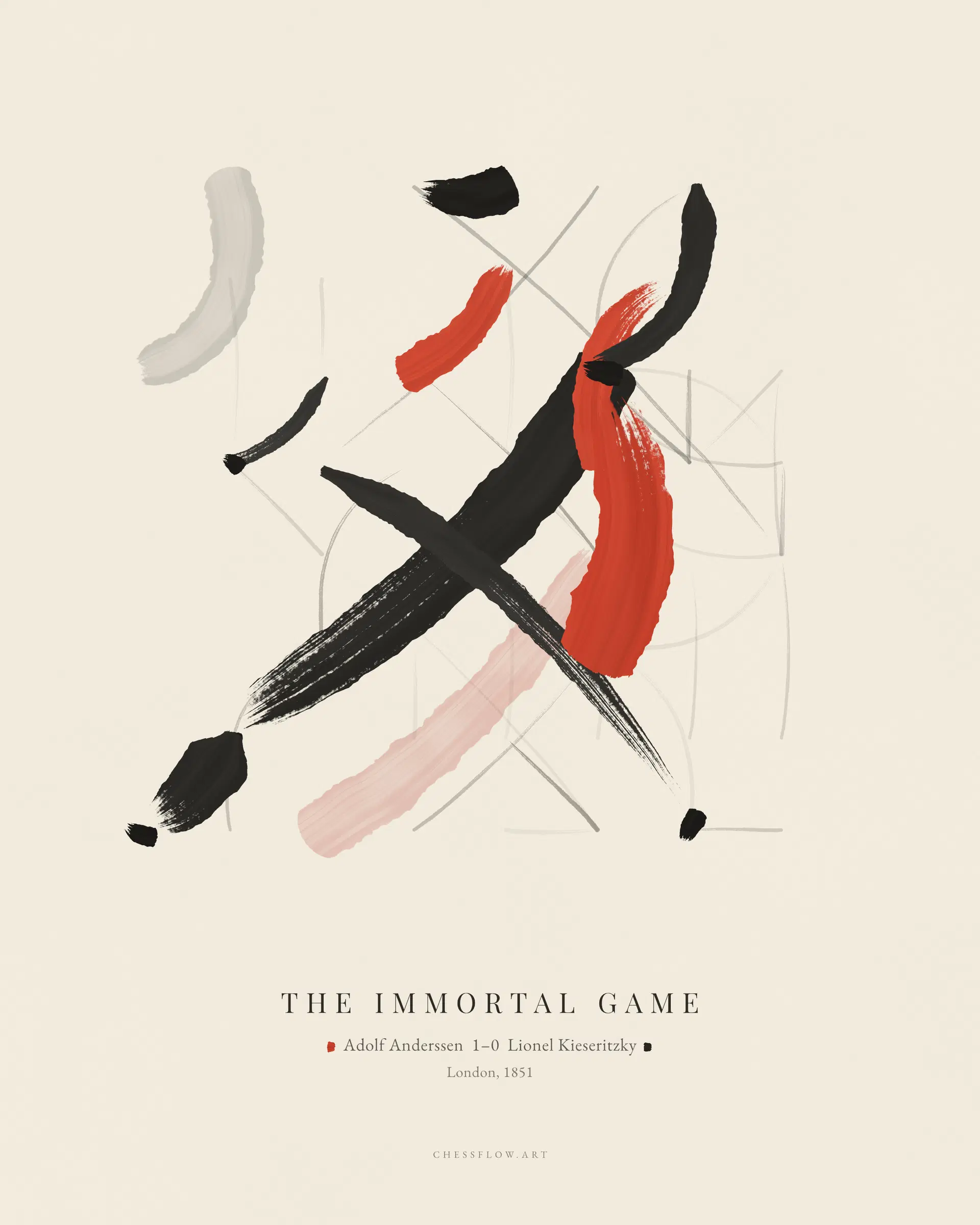
Your own games can be painted the same way. Paste a Chess.com or Lichess link and see it in three styles in a few seconds. It is free to try.